

When Knowledge Becomes Available to Everyone
The traditional model of the chemistry consultant is simple. A scientist spends years mastering a few specialized fields, often within the same industry. Along the way, they build up theoretical knowledge and hands-on know-how. Late in their career, they put that experience to work for companies that don't have this expertise in-house.
This model rests on scarcity: access to specialized knowledge. Artificial intelligence is now erasing that scarcity. A question that once required a call to an expert, or hours in the literature, now gets a structured answer in seconds.
So what place is left for the scientific consultant? My conviction is this: the consultant's value is shifting. It is moving from what they know to what they are willing to take responsibility for.
What the Data Say About Knowledge Work
Knowledge work is among the most exposed to AI, and chemistry is no exception. Five studies help measure the scale of the change.
| Study | What it measures | Key finding |
|---|---|---|
| Eloundou et al., GPTs are GPTs (OpenAI, 2023; published in Science in 2024) | Share of each occupation's tasks that a language model can speed up | About 80% of U.S. workers have at least 10% of their tasks affected, and about 19% have at least half. Higher-paying jobs are more exposed. |
| Mirza et al., ChemBench (Nature Chemistry, 2025) | More than 2,700 chemistry questions put to models and to chemists | On average, the best models outperformed the best chemists in the study. Yet they fail at some basic tasks and give overconfident answers. |
| Dell'Acqua et al., Jagged Technological Frontier (Harvard, BCG, 2023) | 758 consultants from Boston Consulting Group (BCG), a major management consulting firm, with or without AI | On tasks within AI's reach: 12.2% more tasks, 25.1% faster, more than 40% higher quality. On a task outside its reach: 19 percentage points fewer correct answers. |
| Davis, AI is simultaneously aiding and replacing workers, wage data suggest (Federal Reserve Bank of Dallas, February 2026) | Entry-level and experienced wages in 205 U.S. occupations | AI tends to replace entry-level jobs built on book knowledge and to complement workers whose field experience is highly valued. In those exposed occupations, wages are rising. |
| PwC, 2026 Global AI Jobs Barometer (June 2026) | More than a billion job postings in 27 countries and territories | Roles where AI absorbs routine work and emphasizes human judgment are growing twice as fast as those it makes accessible to non-experts. |
Taken together, these studies paint a consistent picture. AI hits knowledge work first: the study by Eloundou and colleagues shows that the highest-paid jobs are the most exposed. AI has already mastered theoretical knowledge: in ChemBench, published in Nature Chemistry, the best models outperformed the best chemists tested, on average.
However, these same models fail at some basic tasks and answer with too much confidence. The Harvard-BCG study shows the cost: on a task outside AI's reach, consultants who used it were 19 percentage points less likely to find the right answer than those who worked without it.
The labour market is starting to take notice. According to the Federal Reserve Bank of Dallas, AI tends to replace entry-level positions built on theoretical knowledge while complementing experienced workers: in exposed occupations where field experience is highly valued, wages are rising. PwC's 2026 barometer, drawn from more than a billion job postings, points the same way: roles where AI absorbs routine work and leaves more room for human judgment are growing twice as fast as those it makes accessible to non-experts.
In other words, information is no longer the bottleneck. What is becoming scarce is judgment: knowing when to trust AI, and being willing to answer for the decision that follows.
What AI Won't Replace: Making the Call and Owning It
Even with all the information available, a project needs someone who says: “We're going with this angle, with this game plan.” An AI can list the options and argue each one well. But ask it which one to pick, and its answer becomes far less reliable.
On a well-established factual question, several AIs will give roughly the same answer. When there is no single right answer, the picture changes. Researchers at the University of Pennsylvania put four nuanced clinical decisions to six AI models, five times each. The models contradicted one another, and even changed their minds from one run to the next on the identical question (Penn LDI). So an AI doesn't really choose: it produces a plausible answer. That answer can change with the next query, without the AI bearing the slightest consequence.
That is where the consultant's value lies. A consultant doesn't change their recommendation from one question to the next: when they make a call, they commit and put their reputation as an expert on the line. If the recommended method doesn't hold up, it's their name, or their company's, that is attached to the result, not a piece of software's.
This responsibility is more than a matter of image. In Quebec, members of the Ordre des chimistes du Québec must carry professional liability insurance under a regulation of the Ordre. The Barreau du Québec, the province's bar association, makes the same argument for law: when a lawyer makes a mistake, the client can be compensated, which is not the case when the error comes from a machine (Noovo Info).
This commitment also translates into concrete protection. A well-insured consultant offers three kinds that no AI does:
| Insurance | What it covers | Lab example |
|---|---|---|
| Professional liability (errors and omissions) | Financial losses caused by advice, an error or an omission in the consultant's work | A method validated too quickly leads to a batch recall |
| Commercial general liability | Bodily injury or property damage caused to third parties during the engagement | An instrument is damaged during an on-site intervention |
| Cyber insurance | Response costs and claims tied to a breach or attack affecting data | A client's confidential test results are exposed |
Sources: Zurich, McCarthy Tétrault.
On the AI side, it's the opposite. OpenAI's terms of use, for example, cap its liability at the amount paid over the previous 12 months, or US$100, and exclude indirect damages (ConductAtlas). In other words, if AI-generated advice costs you a production batch, you absorb the loss.
A firm decision always carries some risk. The client isn't just buying an answer: they're buying someone willing to share that risk with them.
Taking Charge of the Project, on the Ground
Making the call isn't enough: the decision has to be carried through. The consultant takes charge of the project, owns the consequences and coordinates everyone's role. They make sure the technician, the instrument supplier and the manager are pulling in the same direction. For a concrete example, see our article You've Just Bought an Analytical Instrument: How to Make Sure It Delivers the Results You Expect.
They also observe the facts in their real context, not just in silico. An AI analyzes what it's told. It doesn't see the improperly stored sample, the poorly rinsed glassware or the calibration rushed through on a Friday afternoon.
Recent chemistry literature points the same way. A 2026 review in JACS Au on autonomous laboratories stresses that language models have no experience of the physical world: they learn only from text. They don't see the cloudy sample or the skipped step, which exposes them to errors that are unacceptable in a lab. The authors propose a model in which scientists remain responsible for framing, interpretation and oversight.
I've seen this firsthand as director of an industrial oil analysis laboratory handling more than 10,000 samples a year. The costliest problems almost never came from a lack of theoretical knowledge. They came from a detail on the ground that nobody had noticed, or a decision nobody dared to make.
This is exactly the kind of work that falls outside the AI “frontier” described by the Harvard-BCG study: contextual, physical and ambiguous. On that ground, AI becomes an excellent tool in the consultant's hands, not their replacement.
What If AI Ended Up Coordinating Too?
The objection is fair. AI agents already plan tasks, follow up with suppliers and produce reports. There's nothing to stop us from imagining that they will one day manage entire projects.
That's possible, and I don't doubt AI's progress. I'm focusing on what remains once everything else is automated. The more AI takes over execution, the more pressing the question becomes: who validated the choice, and who answers for it if things go wrong? A software vendor won't come to your plant floor to explain to your client why a batch was wrongly released as compliant.
So AI reduces the time spent executing, but it concentrates value on the human who takes a position. Tomorrow's consultant may coordinate AI agents rather than people. They will still be the one who signs.
What This Changes, for Companies and for Chemists
For lab and plant managers, the question is no longer “Who knows the answer?” Your team can already get a good theoretical answer in seconds. The real question becomes: “Who will choose the option, implement it and answer for the result?” That is the role a consultant must fill today.
For chemists and scientists, the career plan is changing too. Specializing for twenty years in order to sell your knowledge late in your career becomes a risky strategy, since that knowledge will be increasingly available for free. It seems wiser to me to start developing now the skills that AI doesn't replace:
- taking a position and defending a recommendation
- managing a project and coordinating people
- reading a real situation, on the floor, and not just in a report
- using AI as a tool while recognizing its blind spots
This isn't the end of the profession. It's a shift: less reciting of knowledge, more judgment and commitment.
The Solutions Are Within Reach; Someone Still Has to Make the Call
AI has made answers abundant. What remains rare is someone willing to choose one, implement it on the ground and answer for it.
That is the spirit in which I founded Labo-Secours. For a chemist or scientist who wants to keep solving real problems, it's the path that seems most promising to me, now that theoretical solutions are within reach. Labo-Secours supports Quebec laboratories with instrument troubleshooting, method development and validation, project management and scientific continuity, combining AI with human judgment that is willing to commit.
Talk to Labo-Secours about your project if you're looking for someone who takes a position and sees the job through.
Sources
- Eloundou, T., Manning, S., Mishkin, P. and Rock, D. (2023). GPTs are GPTs: An Early Look at the Labor Market Impact Potential of Large Language Models. arXiv; revised version published in Science (2024).
- Mirza, A. et al. (2025). A framework for evaluating the chemical knowledge and reasoning abilities of large language models against the expertise of chemists. Nature Chemistry, 17, 1027-1034.
- Dell'Acqua, F. et al. (2023). Navigating the Jagged Technological Frontier: Field Experimental Evidence of the Effects of AI on Knowledge Worker Productivity and Quality. Harvard Business School, working paper.
- Ordre des chimistes du Québec (2001). Règlement sur l'assurance de la responsabilité professionnelle des membres de l'Ordre des chimistes du Québec (regulation on professional liability insurance). Gazette officielle du Québec.
- Noovo Info. Le Barreau du Québec plaide la prudence face à l'intelligence artificielle (in French).
- Davis, S. (February 24, 2026). AI is simultaneously aiding and replacing workers, wage data suggest. Dallas Fed Economics, Federal Reserve Bank of Dallas.
- PwC (June 15, 2026). 2026 Global AI Jobs Barometer.
- JACS Au (2026). Autonomous Chemistry and Materials Innovation Driven by Scientific Agents, vol. 6, no. 5.
- Penn LDI (2025). Get a Second Opinion: Generative AI Produces Inconsistent Medical Recommendations, summary of Landon, Savage et al., Journal of General Internal Medicine.
- Zurich. Différences entre l'assurance responsabilité civile entreprise et l'assurance responsabilité civile professionnelle (in French).
- McCarthy Tétrault (2026). Tendances en matière de cyberassurance : perspectives 2026 sur les incidents de confidentialité, partie 5 (in French).
- ConductAtlas. OpenAI Terms of Use: Limitation of Liability.
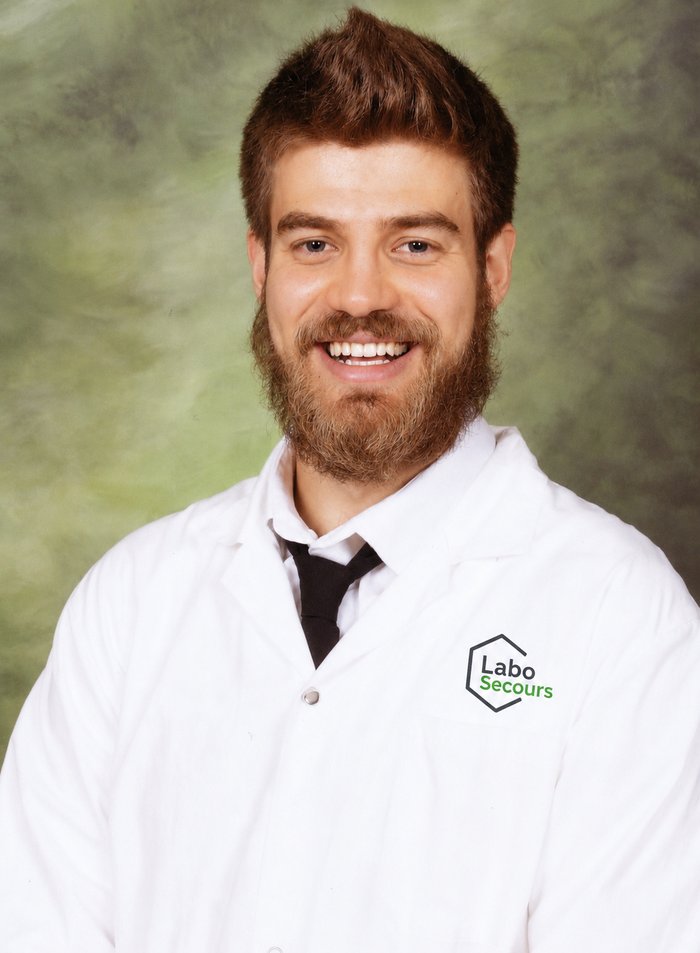
Étienne Blais, M.Sc.
is the founder and principal consultant at Labo-Secours, based in Sherbrooke, Quebec. He led the industrial oil analysis laboratory at Oleum Technologies (over 10,000 samples per year) before founding Labo-Secours, where he provides consulting services in analytical method development and validation, instrumentation, and laboratory management for Quebec industrial companies.